
How to Survive a Japanese Convenience Store

Useful Japanese phrases for 7-Eleven, FamilyMart, Lawson, and more
Japanese convenience stores are amazing.
You can grab an onigiri at midnight, withdraw cash, print documents, send a package, buy tickets, and even pay your bills.
Everything seems easy.
Until you get to the register.
「袋はいりますか?ー Fukuro wa irimasu ka?
「温めますか? ー Atatamemasu ka?
「お箸つけますか? ー Ohashi tsukemasu ka?
😳
Suddenly, buying one onigiri feels like a Japanese listening test.
But don't worry.
You don't need to understand every word the cashier says. If you learn a few common questions and just two very useful answers, you'll be ready for almost any convenience store in Japan.
A Convenience Store Is More Than Just a Store

In Japan, convenience stores are called コンビニ (konbini).
The three biggest names you'll see everywhere are 7-Eleven, FamilyMart, and Lawson.
But Japanese convenience stores aren't just places to buy snacks and drinks. They're almost like tiny service centers.
Depending on the store, you can:
🏧 Use an ATM
Many convenience stores have ATMs, which can be especially useful when you're traveling around Japan.
🖨️ Print, copy, and scan documents
The multi-copy machines can print photos and documents, make copies, scan files, and offer various other services.
📦 Send packages
Need to send luggage or a package somewhere in Japan? Many convenience stores accept delivery services.
🎫 Buy tickets
Concerts, events, theme parks, sports, highway buses, and other tickets can sometimes be purchased or paid for at convenience stores.
💡 Pay bills
Japanese residents commonly use convenience stores to pay utility bills and other payment slips.
So when you walk into a konbini, you're walking into something that's much closer to a small part of Japan's everyday infrastructure than a simple corner store.
And things are still changing. Self-checkout and hybrid registers are becoming increasingly common, so depending on the store, you may be able to complete a normal purchase without much conversation at all.
But don't rely on that!
Understanding a little Japanese will make the experience much easier.
Konbini Vocabulary

Before we get to the register, here are some words worth knowing.
Japanese | Romaji | English |
コンビニ | Konbini | Convenience store |
レジ | Reji | Cash register |
袋 | Fukuro | Bag |
お箸 | Ohashi | Chopsticks |
スプーン | Supūn | Spoon |
フォーク | Fōku | Fork |
ストロー | Sutorō | Straw |
レシート | Reshīto | Receipt |
ポイントカード | Pointo kādo | Point card |
現金 | Genkin | Cash |
お弁当 | Obentō | Bento / boxed meal |
おにぎり | Onigiri | Rice ball |
温める | Atatameru | To heat up |
会計 | Kaikei | Payment / checkout |
宅急便 | Takkyūbin | Delivery service |
コピー | Kopī | Copy |
ATM | Ē-tī-emu | ATM |
You don't need to memorize all of these.
The most useful words are the ones you're likely to hear at the register.
Welcome to the Real Japanese Listening Test
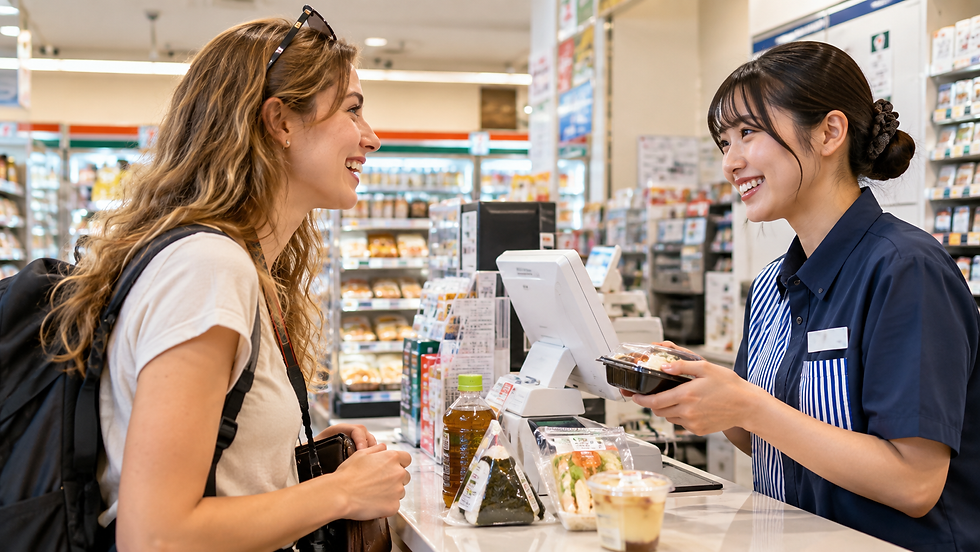
You've chosen your onigiri.
You've found your drink.
You've somehow bought three desserts you didn't need.
Now you walk up to the register.
This is where the Japanese begins.
Here are some of the most common questions you may hear.
① 袋はいりますか? ー Fukuro wa irimasu ka?
→ Do you need a bag?
You might also hear:
袋はご利用ですか?
→ Both are basically asking whether you want a bag.
② 温めますか? ー Atatamemasu ka?
→ Would you like me to heat it up?
You'll often hear this when buying bento, pasta, rice dishes, or other prepared foods.
③ お箸つけますか? ー Ohashi tsukemasu ka?
→ Would you like chopsticks?
Depending on what you buy, they might ask about a spoon, fork, or straw instead.
④ ポイントカードはお持ちですか? ー Pointo kādo wa omochi desu ka?
→ Do you have a point card?
If you're just visiting Japan, your answer will probably be no.
And that's completely fine.
⑤ レシートはいりますか? ー Reshīto wa irimasu ka?
→ Do you need the receipt?
You may hear slightly different versions of this depending on the store and staff member, but listen for the word レシート.
⑥ 年齢確認をお願いします。 ー Nenrei kakunin o onegaishimasu.
→ Please confirm your age.
If you're buying alcohol or tobacco, you may need to confirm that you're old enough to purchase it.
Sometimes this simply means pressing a confirmation button on the register screen.
The TWO Phrases You Absolutely Need to Remember
Okay.
Forget everything else for a second.
If you only remember two phrases from this article, make them these:
お願いします。 ー Onegaishimasu.
→ Yes, please.
Want a bag? →→→ Onegai shimasu
Want chopsticks? →→→ Onegai shimasu
Want it heated up? →→→ Onegai shimasu
This one phrase will get you surprisingly far in Japan.
And then there's the opposite:
大丈夫です。 ー Daijōbu desu.
→ No, thank you. / I'm good.
This one can be confusing because 大丈夫 often means something like "okay" or "all right."
But when someone offers you something in a store, saying 大丈夫です often means:
"I'm okay without it."
Bag? →→→ Daijoubu desu
Receipt? →→→ Daijoubu desu
Chopsticks? →→→ Daijoubu desu
So remember:
Onegai shimasu = Yes, please.
Daijoubu desu = No, thank you.
Honestly, these two phrases alone can save you in a lot more places than just a convenience store.
A Little Extra: Yohei's Top 3 Konbini Sweets 🍰
Okay, Japanese lesson over for a second.
I go to convenience stores way more often than I probably should, and one of the best parts is checking the dessert section.
So here are three sweets to look out for, one from each of the big three convenience stores.
🥇 Lawson: Doramocchi Mont Blanc

Lawson's どらもっち モンブラン (Doramocchi Mont Blanc) combines a chewy dorayaki-style outside with rich Italian chestnut paste and smooth marron cream.
It's basically Japan meets France inside a convenience store dessert.
Price: ¥268
🥈 7-Eleven: Chilled Mitarashi Dango

For something more traditionally Japanese, try 冷やしみたらし団子 (Chilled Mitarashi Dango).
Soft and chewy rice dumplings are served in a generous amount of sweet and savory soy sauce glaze.
This version is served chilled, making it especially smooth and refreshing.
Price: Around ¥250
🥉 FamilyMart: Nama Canelé Stick Cake

FamilyMart's 生カヌレスティックケーキ (Nama Canelé Stick Cake) is a unique twist on the classic French canelé.
It has a caramelized outside with a chewy texture inside, plus creamy filling sandwiched in the middle.
Price: ¥238
Want to Practice Before You Try It? 🇯🇵

Knowing the phrases is one thing.
Actually hearing them at a real convenience store and answering without freezing is another!
That's exactly what we practice at Japanguin.

Practice the Japanese you'll actually need before you arrive.
Instead of memorizing complicated grammar, we'll focus on real situations like convenience stores, restaurants, cafés, shopping, transportation, and talking with locals.

Let's get out of the classroom and use Japanese in the real world!
In our Survival Japanese Lesson, you'll learn practical phrases and then practice them in real situations around Tokyo.
You don't need to speak perfect Japanese.
You just need enough Japanese to make your trip a little easier, more fun, and more local.
Learn it. Use it. Enjoy Japan. 🇯🇵🐧


Comments